
Via bestrooftalkever:
HOW HAVE I NEVER SEEN THIS BEFORE.


Via tmiesen:
“Old” advertising isn’t dead, it’s just begging for new ideas. I’m hooked on this magazine ad concept.
Via bestrooftalkever:
HOW HAVE I NEVER SEEN THIS BEFORE.

Auto-reblogging my Unconsumption post because:
a) the project is in Toronto, and involves b) adaptive reuse of old buildings, c) the preservation of green space / creation of a nature preserve, d) a public-private (non-profit) partnership, e) a farmers’ market, f) a repurposed shipping container, g) community gardens, and h) sustainable building principles, among other things that are of interest (to me)!
Via unconsumption:
A retired shipping container, known now as the Welcome Hut, helps to orient visitors as they enter the grounds of Toronto’s Evergreen Brick Works (EBW), a new 40-acre nature preserve / redevelopment project — billed as “Canada’s first community environmental center.” EBW is a project of Evergreen, a national charity dedicated to bringing nature into public spaces, schools, and homes.
Several components of EBW’s master plan have been completed on the site that was, for more than a century, a brick factory with massive kilns (decommissioned in the 1980s), with adjacent clay/shale quarry in a ravine along the Don River.
From an August 2010 Toronto Life story:
In an earlier age, Toronto would have torn down the brick sheds, but we are beginning to see new value in these old places. We don’t just come for the food or the chit-chat with a charming artisanal cheesemaker. We also come for the worn-down bricks and the history immersion. We crave these historic buildings that can root us in our city’s past and tell us where we came from. The fashion for ruins was also hugely popular in 18th-century England. Back then, people were leaving the land to work in factories. Similarly, as our factories close, we’re developing a nostalgic appreciation for manufacturing.
EBW’s offerings are slated to include a sustainable garden center, farmers’ market, demonstration gardens and kitchens, conference and event facilities, community bike space, art exhibition areas, and programs for families and kids.
The Welcome Hut — Dwell.com slideshow here — was designed so that it could be relocated elsewhere on the property, to serve other purposes as needed.
(spotted on Twitter, via Dwell’s Miyoko Ohtake, @miyokoohtake)
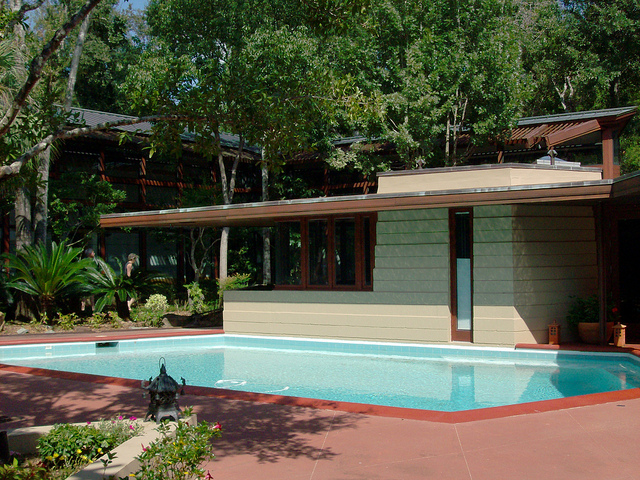
Architect Frank Lloyd Wright made it easy for the owners of his Houston home to take a dip in their swimming pool:
His design for the bathroom featured the narrow vertical opening pictured above – a door that swings out over the pool’s edge!
Seeing the house on Sunday was quite a treat; additional photos (and notes) from my visit can be found here.
During the visit, we learned Mr. Wright never visited the site, and he didn’t envision the house being air conditioned – he thought natural ventilation would be adequate. The original owner who commissioned Wright (in 1954) to design the home insisted that AC be included. Wright complied; the design solution involved the placement of air registers in the home’s concrete floors.
In addition, we learned the current owner bought the house in 1991, after the New York Times ran this story – Houston Journal - A House With a History May Not Have a Future - NYTimes.com. From 1991-95, the owner renovated the house, removing up to six layers of paint (in shades of pink and white) in some areas, and expanded it, adding some 7,000+ square feet of space. In the living room, ceiling tiles were removed, exposing the angled ceiling, and a banquette and other furniture was built from specs found in the home’s original plans.
Let’s hope that future owners are as good stewards of the home’s architectural heritage as the current one.
(Background about the house and my visit here, in my last post.)
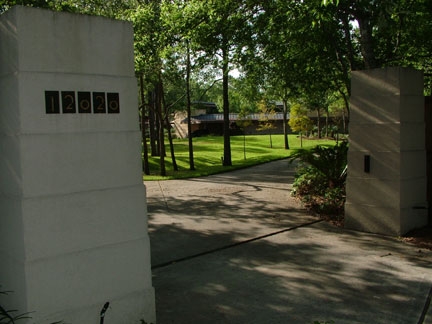
Wright stuff:
I’m excited to be part of a small group visiting Frank Lloyd Wright’s one contribution to architecture in the city of Houston – a private residence located in the Memorial area.
Among the few stories I’ve found online about the house (designed in 1954) is this New York Times piece from 1991: Houston Journal - A House With a History May Not Have a Future - NYTimes.com. Even then, almost 20 years ago, the house was threatened by possible demolition. Since then, from what I’ve been told, significant modifications, including an addition (designed by Kirksey), have been made to the house.
I like this, from the NYT:
Mr. Thaxton [original owner who commissioned Wright] said it cost $125,000 to build the house, an astronomical sum at the time. The amount included Wright’s $25,000 fee. “You didn’t work with Mr. Wright,” Mr. Thaxton said. “You presented Mr. Wright with a piece of property.”
The house is owner-occupied, so we don’t know if we’ll be allowed to take photos today. Will take a few, if it’s okay.
Related: Previous posts about the preservation and maintenance of Wright-designed properties elsewhere.