“The average US consumer is never more than 3 feet away from their phone. The average smart phone user checks their phone 40 times a day.”
Via paddyhirsch:
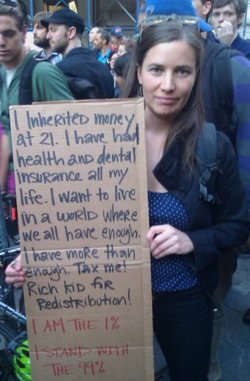
I am the one percent. I stand with the 99 percent.
Via paddyhirsch:
I am the one percent. I stand with the 99 percent.
“The average US consumer is never more than 3 feet away from their phone. The average smart phone user checks their phone 40 times a day.”

Via unconsumption:
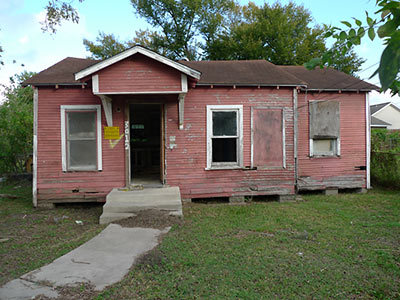
The Houston artistic team of Dan Havel and Dean Ruck is at it again. (Previous mentions here and here.) Thanks to their handiwork, another old bungalow slated for demolition is being transformed into architectural artwork.
The public art project, which Havel and Ruck designed to function as a stage, is a temporary centerpiece in a new pocket park in Houston’s Fifth Ward, a neighborhood developed in the late 1800s. The Fifth Ward went into decline in the 1970s; in recent years, the area’s been undergoing redevelopment and revitalization. [Side note: Former residents include Congresswoman Barbara Jordan and musician Arnett Cobb.]
Photo above via Fifth Ward Jam - Houston Arts Alliance.
Pre-deconstruction photo below (by Havel Ruck Projects) via Swamplot.com.
For additional photos and information, see this Swamplot post.
Houston!

wnyc:
Designer David Hanauer finds beauty in the aerial abstraction of Google Maps — specifically, the urban morass of Los Angeles and Las Vegas. Not content to merely soak in overhead shots of pools and freeways, Hanauer began creating collaged patterns that quickly transitioned into carpets. These beautiful rugs are available for purchase on his website.
(via TeenAngster)
This is a carpet.
Not sure I could step on this without feeling dizzy…or terrifyingly omnipotent.
Via gardensinunexpectedplaces:
Via steveleathers:
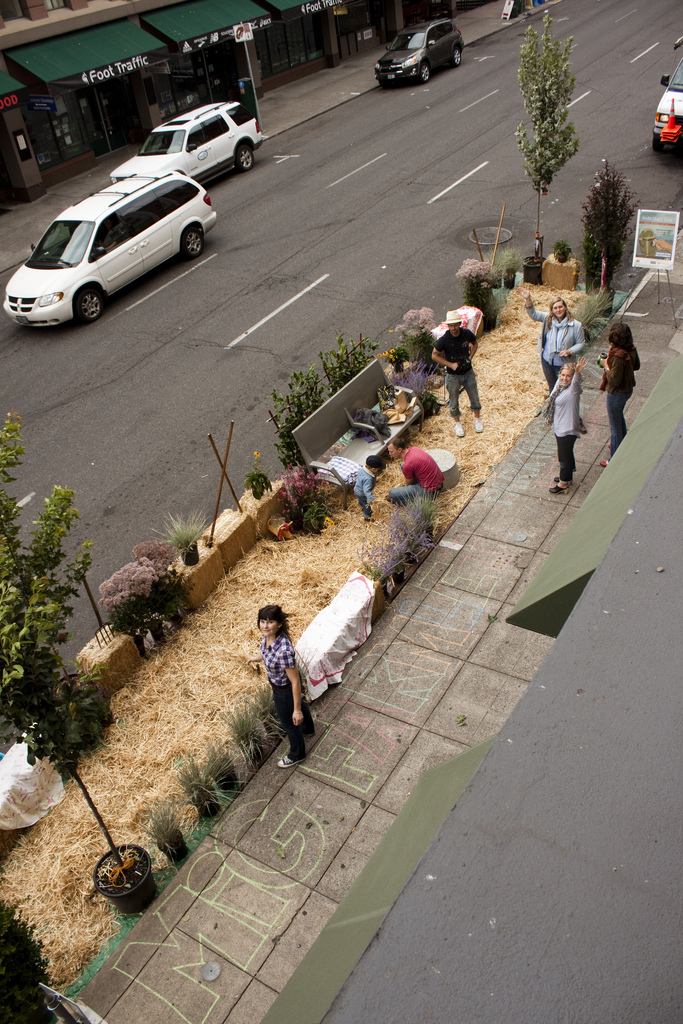
For PARK(ing) Day, my company created an Urban Farmlet on SW 2nd Street in Portland (between Taylor and Yamhill).
It’s only two parking spots, but it feels like a lot more. If you’re in the area, come by and check it out. Have some lemonade. Enjoy some space that you normally wouldn’t have the chance to.
Happy 2011 PARK(ing) Day, y’all.
PARK(ing) Day is an annual, worldwide event that invites citizens everywhere to transform metered parking spots into temporary parks for the public good.
Click here to view a map of cities where residents have set up pop-up parks.
See also: Earlier Gardens in Unexpected Places post here.
Today, in “things I love.”

Via theatlantic:
How Will Shortz Makes a New York Times Crossword Puzzle
“Every crossword in the Times is a collaboration between the puzzle-maker and the puzzle editor. On average, about half the clues are mine. I may edit as few as five or ten percent of the clues, or as many as 95 percent for someone who does a great puzzle but not great clues. Why accept a puzzle when I’m going to edit 95 percent of the clues? Well, if someone sends me a great puzzle with an excellent theme and construction—you want fresh, interesting, familiar vocabulary throughout the grid—I feel it would be a shame to reject it on account of the clues, because I can always change them myself.
This puzzle came from Elizabeth Gorski, one of the pros. Liz is great at putting fresh entries at the short spaces of a grid. That’s very hard to do. There was one thing about the construction I didn’t like, and that was at 35 Down. The answer was LORELAI, and the sirens on the Rhine are of course “Lorelei,” with an “e-i.” Liz’s clue was Rory’s mom on Gilmore Girls, and I didn’t think followers should have to know that. Sometimes I’ll do little fixes myself. But this was big enough that I asked her to revise the grid. You can see the new letters in blue, where I’ve amended the manuscript. Then the puzzle is accepted. I earmarked it for a Wednesday, because the theme consists of straight-forward English, but it’s a little playful.”
Read more at The Atlantic

Via timemagazine:
“We move forward but it stays with us.” These aren’t Jenny Holzer’s words, but she’s the artist who molded them into a visual titan. This photo-illustration, now the back cover of our “Beyond 9/11” Special Commemorative Issue, is Holzer’s rendering of the significance of 9/11, done in her signature style. What we see are these words transposed onto towers that fell 10 years ago.
The phrasing actually belongs to Howard Lutnik, the CEO of Cantor Fitzgerald, the company whose offices took up the 101 to the 105 floors of the World Trade Center’s north tower. Lutnik took the morning off from work on Sept. 11, 2001 to take his son Kyle to his first day of kindergarten, and was interviewed about that day (along with his son, now a freshman in high school) as a part of our “Beyond 9/11” project.
After graduating from the Rhode Island School of Design in the late 1970s, Holzer began coining her artistic trademark by writing short slogans in public places. “If you want to reach a general audience,” she told TIME in 1990, “it’s not art issues that are going to compel them to stop on their way to lunch, it has to be life issues.” She went on to project her “truisms” onto famous cityscapes all over the world.
“Beyond 9/11” began as a series of portraits of the 40 men and women whose lives are forever tethered to that day, but we quickly realized that their words held as much power as their images. Executive editor Radhika Jones says Holzer’s work is “a beautiful marriage” between the artistic vision of this issue and the significance of the words behind them. Now, her 9/11 back cover image, wrapped in silver, sits next to Julian LaVerdiere and Paul Myoda’s “Tribute in Light Years,” a tribute to the buildings that are lost to us now.